轻量级大语言模型MiniMind源码解读(四):旋转位置编码原理与应用全解析
正余弦位置编码的最大问题,在于它将绝对位置信息编码成固定的向量,然后通过加法加入token embedding。这种方式虽然能提供位置信息,但在注意力计算(q·k)中很容易被抵消,特别是高维度(较大的i)频率较低时,对短距离位置变化非常不敏感,导致模型在长序列任务中“分不清细节”。
为了解决这个问题,RoPE(Rotary Positional Embedding)通过一种旋转变换,将位置信息直接融入到q和k的表示中。
和正余弦编码一样,RoPE也没有引入需要学习的参数,但是RoPE将位置信息的引入方式从原来的“对于输入token的加法操作”变成了“对于q和k的旋转操作”,并且以绝对位置编码的形式实现了相对位置编码。
相对位置信息,即两个词向量(token embedding)之间的相对距离,假设在一个seq_length=100的序列中,两个词向量的位置pos分别为m和n,那它们之间的相对距离就是m-n,RoPE的目标就是在位置编码时引入m-n这一相对位置信息。
RoPE的目标,正是找到一种旋转操作,使得在不显式计算位置差m-n的情况下,位置编码自然地将“相对位置信息”融入到注意力机制中的$qk$中。换句话说,需要找到这么一种映射$g$,针对给定的两个用于计算注意力的向量$q$和$k$,以及m-n,使得
$$f(q,m)f(k,n)=g(q,k,m-n)$$
其中,$q$和$k$是长度为$d_{model}$的向量,m和n分别是对应向量中第m个和第n个pos处的元素。
参考:
https://zhuanlan.zhihu.com/p/667864459
https://kexue.fm/archives/8265/comment-page-2
一、回顾二维向量的旋转操作
根据线性代数的知识,二维向量的旋转操作,指的是对该二维向量施加一个旋转矩阵变换,变换前后只改变二维向量的方向而保持其模长不变。
给定一个二维向量:
$$
\mathbf{x} = \begin{bmatrix} x \ y \end{bmatrix}
$$
我们希望将它在二维平面上逆时针旋转一个角度 $\theta$,可以通过乘以旋转矩阵来实现:
$$
\mathbf{x}_{\text{rot}} = R(\theta) \cdot \mathbf{x}
$$
其中旋转矩阵 $R(\theta)$ 为:
$$
R(\theta) =
\begin{bmatrix}
\cos \theta & -\sin \theta \
\sin \theta & \cos \theta
\end{bmatrix}
$$
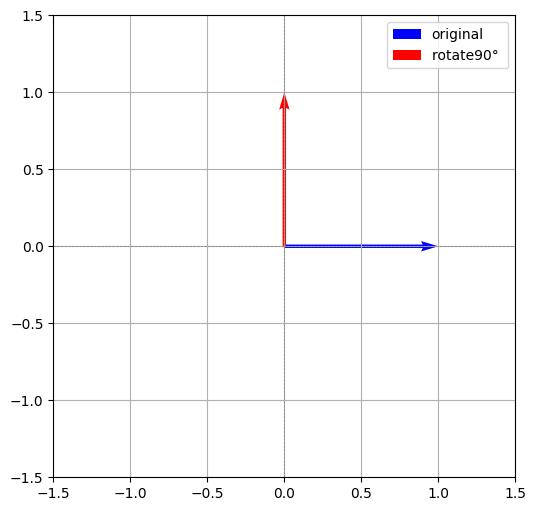
举个实际例子,若 $$\mathbf{x} = \begin{bmatrix} 1 \ 0 \end{bmatrix}$$ 且 $$\theta = \frac{\pi}{2}$$
(即逆时针旋转 90°):
$$
\mathbf{x}_{\text{rot}} =
\begin{bmatrix}
\cos \frac{\pi}{2} & -\sin \frac{\pi}{2} \
\sin \frac{\pi}{2} & \cos \frac{\pi}{2}
\end{bmatrix}
\begin{bmatrix}
1 \
0
\end{bmatrix}
\begin{bmatrix}
0 \
1
\end{bmatrix}
$$
即:向量从 $$(1, 0)$$ 旋转为 $$(0, 1)$$
用代码可视化上述旋转过程,如下:
1 | import numpy as np |
二、RoPE的工作原理(d_model=2)
前面说过,RoPE 是将位置信息通过旋转操作直接注入到注意力机制中的 $q$ 和 $k$ 向量中。
假设:
- 模型维度:$d_{\text{model}} = 2$
- 原始向量:
$$
\mathbf{q} = \begin{bmatrix} 1 \ 2 \end{bmatrix}, \quad \mathbf{k} = \begin{bmatrix} 3 \ 4 \end{bmatrix}
$$ - 序列位置:设为 $\text{pos}_q = m$,$\text{pos}_k = n$
- 对应位置角频率为 $\theta = \omega \cdot \text{pos}$,其中 $\omega$ 是一个频率超参数
Step 1: 对 q 和 k 分别旋转
定义二维旋转操作为:
$$
\text{RoPE}(\mathbf{x}, \theta) =
\begin{bmatrix}
\cos \theta & -\sin \theta \
\sin \theta & \cos \theta
\end{bmatrix}
\cdot \mathbf{x}
$$
分别对 $\mathbf{q}$ 和 $\mathbf{k}$ 施加旋转:
- 设 $\theta_q = \omega \cdot m,\quad \theta_k = \omega \cdot n$
- 旋转后的向量为:
$$
\tilde{\mathbf{q}} = R(\theta_q)\cdot \mathbf{q}, \quad
\tilde{\mathbf{k}} = R(\theta_k)\cdot \mathbf{k}
$$
Step 2: 点积操作变成了相对位置信息的函数
旋转后计算注意力时,执行的是:
$$
\tilde{\mathbf{q}}^\top \cdot \tilde{\mathbf{k}} = \mathbf{q}^\top R(-\theta_q) R(\theta_k) \cdot \mathbf{k}
= \mathbf{q}^\top R(\theta_k - \theta_q) \cdot \mathbf{k}
$$
即:
RoPE 实现了 “绝对位置编码方式得到的相对位置感知”:注意力变成了与 $(n - m)$(即位置差)相关的点积结果。
示例(假设 $\omega = 1$, $m = 1$, $n = 2$)
- 则 $\theta_q = 1$, $\theta_k = 2$
- $R(\theta_k - \theta_q) = R(1)$
那么有:
1 | import numpy as np |
事实上,RoPE将每对特征维度(比如 [x₀, x₁])看作是二维平面上的一个点(x₀, x₁),然后将其绕原点(0, 0)顺时针或逆时针旋转一个角度θ(由位置pos决定),这个操作的数学本质就是二维向量绕原点旋转。
这个旋转中心正是(0, 0)。所以可以想象:特征 [x0, x1] 像一个在平面上的箭头,RoPE 让它随着token的位置pos增大不断绕原点旋转,旋转角度=pos × freq_i。
三、推广到高维向量(词向量,d_model维,d_model >> 2)
上面介绍了当向量为二维时,RoPE的工作原理。
当向量维度非常高时,比如词向量的维度,可以把高维向量中不同位置(i)的元素两两分成一组,分别执行旋转操作,如下:
$$
\boldsymbol{R}{\Theta,m}^{d{model}} \boldsymbol{x} =
\begin{pmatrix}
\cos m\theta_0 & -\sin m\theta_0 & 0 & 0 & \cdots & 0 & 0 \
\sin m\theta_0 & \cos m\theta_0 & 0 & 0 & \cdots & 0 & 0 \
0 & 0 & \cos m\theta_2 & -\sin m\theta_2 & \cdots & 0 & 0 \
0 & 0 & \sin m\theta_2 & \cos m\theta_2 & \cdots & 0 & 0 \
\vdots & \vdots & \vdots & \vdots & \ddots & \vdots & \vdots \
0 & 0 & 0 & 0 & \cdots & \cos m\theta_{d_{model}-2} & -\sin m\theta_{d_{model}-2} \
0 & 0 & 0 & 0 & \cdots & \sin m\theta_{d_{model}-2} & \cos m\theta_{d_{model}-2}
\end{pmatrix}
\begin{pmatrix}
x_0 \
x_1 \
x_2 \
\vdots \
x_{d_{model}-2} \
x_{d_{model}-1}
\end{pmatrix}
$$
其中,$\Theta=\left{\theta_i=\omega^{-\frac{i}{d_{model}}}, i \in [0, 2, \ldots, d_{model}-2] \right}$。
注意,公式中的m指的是pos,即序列中第m个词向量的pos=m,之所以不用pos,是为了使得公式看起来简洁。
这个高维旋转矩阵是高度稀疏的,在代码实现时,通常改写成如下方式进行替代,以减少冗余计算:
$$
\boldsymbol{R}{\Theta,m}^{d{model}} \boldsymbol{x} =
\begin{pmatrix}
x_{0} \
x_{1} \
x_{2} \
x_{3} \
\vdots \
x_{d_{model}-2} \
x_{d_{model}-1}
\end{pmatrix}
\otimes
\begin{pmatrix}
\cos m\theta_0 \
\cos m\theta_0 \
\cos m\theta_2 \
\cos m\theta_2 \
\vdots \
\cos m\theta_{d_{model}-2} \
\cos m\theta_{d_{model}-2}
\end{pmatrix}
+
\begin{pmatrix}
-x_{1} \
x_{0} \
-x_{3} \
x_{2} \
\vdots \
-x_{d_{model}-1} \
x_{d_{model}-2}
\end{pmatrix}
\otimes
\begin{pmatrix}
\sin m\theta_0 \
\sin m\theta_0 \
\sin m\theta_2 \
\sin m\theta_2 \
\vdots \
\sin m\theta_{d_{model}-2} \
\sin m\theta_{d_{model}-2}
\end{pmatrix}
$$
可以看到,经过RoPE,词向量的维度不变(仍为$d_{model}$)。
四、高维RoPE 示例:d_model = 4, omiga = 10000, pos = 2
假设原始向量(如query向量)为:
$$
\mathbf{q} = [1,\ 0,\ 0,\ 1]
$$
第一步:计算频率
对于 $d_{model} = 4$,每2个维度一对:
$$
\text{freqs} = \left[ \frac{1}{10000^{0/4}},\ \frac{1}{10000^{2/4}} \right] = [1.0,\ 0.01]
$$
位置 $pos = 2$ 时,对应旋转角度为:
$$
\theta_0 = 2 \cdot 1.0 = 2.0 \
\theta_1 = 2 \cdot 0.01 = 0.02
$$
第二步:按维度对进行旋转
第1对维度 $(1,\ 0)$,角度 $2.0$:
$$
\begin{bmatrix}
\cos(2) & -\sin(2) \
\sin(2) & \cos(2)
\end{bmatrix}
\cdot
\begin{bmatrix}
1 \
0
\end{bmatrix}
\begin{bmatrix}
\cos(2) \
\sin(2)
\end{bmatrix}
\approx
\begin{bmatrix}
-0.4161 \
0.9093
\end{bmatrix}
$$
第2对维度 $(0,\ 1)$,角度 $0.02$:
$$
\begin{bmatrix}
\cos(0.02) & -\sin(0.02) \
\sin(0.02) & \cos(0.02)
\end{bmatrix}
\cdot
\begin{bmatrix}
0 \
1
\end{bmatrix}
\begin{bmatrix}
-\sin(0.02) \
\cos(0.02)
\end{bmatrix}
\approx
\begin{bmatrix}
-0.02 \
0.9998
\end{bmatrix}
$$
第三步:RoPE 编码后向量
拼接两对旋转结果:
$$
\text{RoPE}(\mathbf{q}) = [-0.4161,\ 0.9093,\ -0.02,\ 0.9998]
$$
PyTorch 验证代码:
1 | import torch |
五、代码实现RoPE
https://zhuanlan.zhihu.com/p/645263524
在MiniMind中实现的RoPE参考了Transformers库的LLaMA模型中RoPE的实现方式,和上述公式有些区别,具体体现在:
假设输入高维向量为q=[1,2,3,4,5,6]
- 应用上述公式做rotate_half(q) –> [-2, 1, -4, 3, -6, 5]
- 应用MiniMind/LLaMa的方法做rotate_half(q) –>[-4, -5, -6, 1, 2, 3]
在这个链接中,证明了两者的等价性: https://discuss.huggingface.co/t/is-llama-rotary-embedding-implementation-correct/44509/2
这里我们展示MiniMind中的RoPE实现代码:
1 | def precompute_freqs_cis(d_model: int, end: int = int(32 * 1024), omiga: float = 1e6): |