什么是FID

Fréchet Inception Distance (FID) 度量了真实图片和生成图片在 feature 层面的距离

FID越小,则图像多样性越好,质量也越好

众所周知,预训练好的神经网络顶层可以提取图片的高级信息,一定程度能反映图片的本质。因此,FID 的提出者通过预训练的 Inception V3 来提取全连接层之前的 2048 维向量,作为图片的特征。 具体的做法是:去掉最后的输出层( 最后一层是一个pooling层,原来的网络通过该pooling层可以输出一张图像的类别 ),然后得到一个2048维的高层特征,这个高层特征是一个长向量形式。

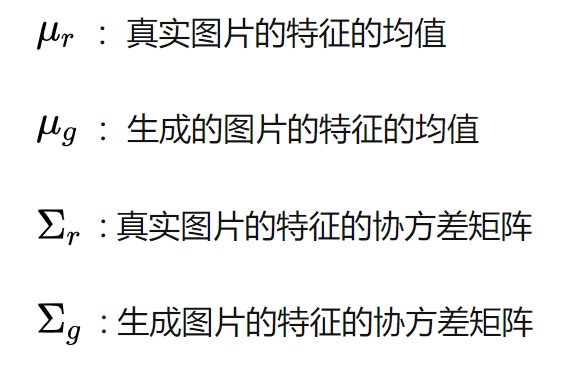
FID的计算公式如下:

在这里,将每一张图片输入分类器中,都会得到一个2048维的长向量,对所有图片得到的长向量求平均值,求协方差矩阵,就得到了公式中的四个部分的值。

FID 只把 Inception V3 作为特征提取器,并不依赖它判断图片的具体类别,因此不必担心 Inception V3 的训练数据和生成模型的训练数据不同。同时,由于直接衡量生成数据和真实数据的分布之间的距离,也不必担心每个类别内部只产生一模一样的图片这种形式的 mode collapse。完美避开了很多 Inception Score 的缺陷。

使用numpy计算FID

1
2
3
4
5
6
7
8
9
10
11
12
13
14
15
16
17
18
19
20
21
22
23
24
25
26
27
28
29
30
31
32
33
34
35
# example of calculating the frechet inception distance
import numpy
from numpy import cov
from numpy import trace
from numpy import iscomplexobj
from numpy.random import random
from scipy.linalg import sqrtm

# calculate frechet inception distance
def calculate_fid(act1, act2):
# calculate mean and covariance statistics
mu1, sigma1 = act1.mean(axis=0), cov(act1, rowvar=False)
mu2, sigma2 = act2.mean(axis=0), cov(act2, rowvar=False)
# calculate sum squared difference between means
ssdiff = numpy.sum((mu1 - mu2)**2.0)
# calculate sqrt of product between cov
covmean = sqrtm(sigma1.dot(sigma2))
# check and correct imaginary numbers from sqrt
if iscomplexobj(covmean):
covmean = covmean.real
# calculate score
fid = ssdiff + trace(sigma1 + sigma2 - 2.0 * covmean)
return fid

# define two collections of activations
act1 = random(10*2048)
act1 = act1.reshape((10,2048))#模拟10张图片,每张图片通过改造的分类器输出得到2018维的长向量(feature)
act2 = random(10*2048)
act2 = act2.reshape((10,2048))#模拟10张图片,每张图片通过改造的分类器输出得到2018维的长向量(feature)
# fid between act1 and act1
fid = calculate_fid(act1, act1)
print('FID (same): %.3f' % fid)
# fid between act1 and act2
fid = calculate_fid(act1, act2)
print('FID (different): %.3f' % fid)
1
2
FID (same): -0.000
FID (different): 356.641

使用Kears预置的Inception V3计算FID

1
2
3
4
5
6
7
8
9
10
11
12
13
14
15
16
17
18
19
20
21
22
23
24
25
26
27
28
29
30
31
32
33
34
35
36
37
38
39
40
41
42
43
44
45
46
47
48
49
50
51
52
53
54
55
56
57
58
59
60
61
62
63
64
65
66
# example of calculating the frechet inception distance in Keras
import numpy
from numpy import cov
from numpy import trace
from numpy import iscomplexobj
from numpy import asarray
from numpy.random import randint
from scipy.linalg import sqrtm
from keras.applications.inception_v3 import InceptionV3
from keras.applications.inception_v3 import preprocess_input
from keras.datasets.mnist import load_data
from skimage.transform import resize

# scale an array of images to a new size
def scale_images(images, new_shape):
images_list = list()
for image in images:
# resize with nearest neighbor interpolation
new_image = resize(image, new_shape, 0)
# store
images_list.append(new_image)
return asarray(images_list)

# calculate frechet inception distance
def calculate_fid(model, images1, images2):
# calculate activations
act1 = model.predict(images1)
act2 = model.predict(images2)
# calculate mean and covariance statistics
mu1, sigma1 = act1.mean(axis=0), cov(act1, rowvar=False)
mu2, sigma2 = act2.mean(axis=0), cov(act2, rowvar=False)
# calculate sum squared difference between means
ssdiff = numpy.sum((mu1 - mu2)**2.0)
# calculate sqrt of product between cov
covmean = sqrtm(sigma1.dot(sigma2))
# check and correct imaginary numbers from sqrt
if iscomplexobj(covmean):
covmean = covmean.real
# calculate score
fid = ssdiff + trace(sigma1 + sigma2 - 2.0 * covmean)
return fid

# prepare the inception v3 model
model = InceptionV3(include_top=False, pooling='avg', input_shape=(299,299,3))
# define two fake collections of images
images1 = randint(0, 255, 10*32*32*3)
images1 = images1.reshape((10,32,32,3))
images2 = randint(0, 255, 10*32*32*3)
images2 = images2.reshape((10,32,32,3))
print('Prepared', images1.shape, images2.shape)
# convert integer to floating point values
images1 = images1.astype('float32')
images2 = images2.astype('float32')
# resize images
images1 = scale_images(images1, (299,299,3))
images2 = scale_images(images2, (299,299,3))
print('Scaled', images1.shape, images2.shape)
# pre-process images
images1 = preprocess_input(images1)
images2 = preprocess_input(images2)
# fid between images1 and images1
fid = calculate_fid(model, images1, images1)
print('FID (same): %.3f' % fid)
# fid between images1 and images2
fid = calculate_fid(model, images1, images2)
print('FID (different): %.3f' % fid)
1
2
3
4
Prepared (10, 32, 32, 3) (10, 32, 32, 3)
Scaled (10, 299, 299, 3) (10, 299, 299, 3)
FID (same): -0.000
FID (different): 47.347

在CIFAR-10上使用Keras内置的Inception V3计算FID

1
2
3
4
5
6
7
8
9
10
11
12
13
14
15
16
17
18
19
20
21
22
23
24
25
26
27
28
29
30
31
32
33
34
35
36
37
38
39
40
41
42
43
44
45
46
47
48
49
50
51
52
53
54
55
56
57
58
59
60
61
62
63
64
# example of calculating the frechet inception distance in Keras for cifar10
import numpy
from numpy import cov
from numpy import trace
from numpy import iscomplexobj
from numpy import asarray
from numpy.random import shuffle
from scipy.linalg import sqrtm
from keras.applications.inception_v3 import InceptionV3
from keras.applications.inception_v3 import preprocess_input
from keras.datasets.mnist import load_data
from skimage.transform import resize
from keras.datasets import cifar10

# scale an array of images to a new size
def scale_images(images, new_shape):
images_list = list()
for image in images:
# resize with nearest neighbor interpolation
new_image = resize(image, new_shape, 0)
# store
images_list.append(new_image)
return asarray(images_list)

# calculate frechet inception distance
def calculate_fid(model, images1, images2):
# calculate activations
act1 = model.predict(images1)
act2 = model.predict(images2)
# calculate mean and covariance statistics
mu1, sigma1 = act1.mean(axis=0), cov(act1, rowvar=False)
mu2, sigma2 = act2.mean(axis=0), cov(act2, rowvar=False)
# calculate sum squared difference between means
ssdiff = numpy.sum((mu1 - mu2)**2.0)
# calculate sqrt of product between cov
covmean = sqrtm(sigma1.dot(sigma2))
# check and correct imaginary numbers from sqrt
if iscomplexobj(covmean):
covmean = covmean.real
# calculate score
fid = ssdiff + trace(sigma1 + sigma2 - 2.0 * covmean)
return fid

# prepare the inception v3 model
model = InceptionV3(include_top=False, pooling='avg', input_shape=(299,299,3))
# load cifar10 images
(images1, _), (images2, _) = cifar10.load_data()
shuffle(images1)
images1 = images1.astype('float32')
images2 = images2.astype('float32')
print('Loaded', images1.shape, images2.shape)
# convert integer to floating point values
images1 = images1.astype('float32')
images2 = images2.astype('float32')
# resize images
images1 = scale_images(images1, (299,299,3))
images2 = scale_images(images2, (299,299,3))
print('Scaled', images1.shape, images2.shape)
# pre-process images
images1 = preprocess_input(images1)
images2 = preprocess_input(images2)
# calculate fid
fid = calculate_fid(model, images1, images2)
print('FID: %.3f' % fid)
1
2
3
Loaded (10, 32, 32, 3) (10, 32, 32, 3)
Scaled (10, 299, 299, 3) (10, 299, 299, 3)
FID: 345.569

参考资料

https://machinelearningmastery.com/how-to-implement-the-frechet-inception-distance-fid-from-scratch/

https://zhuanlan.zhihu.com/p/54213305

https://blog.csdn.net/qq_27261889/article/details/86483505